
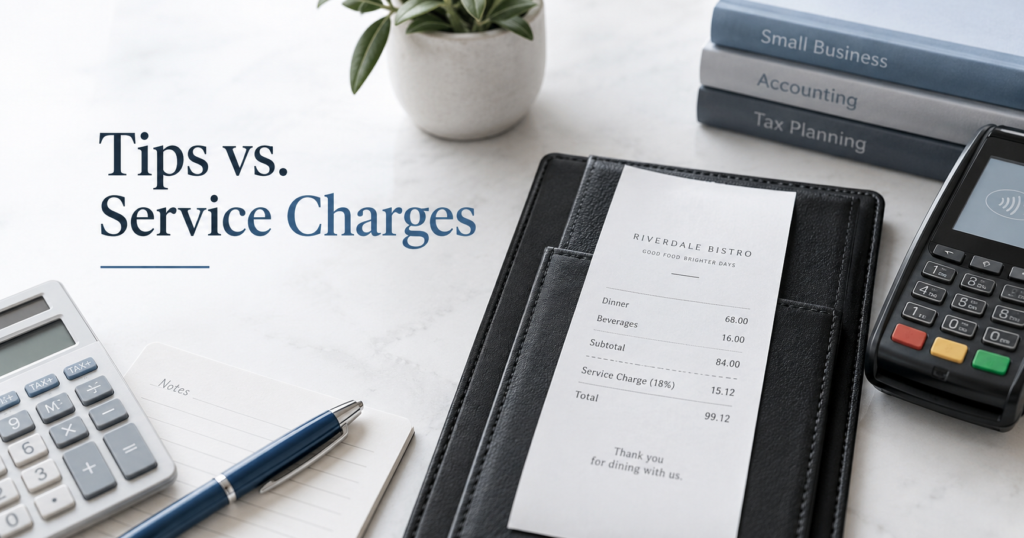
If your business receives tips or adds service charges to customer bills, you may assume they are treated the same for tax and payroll purposes.
They are not.
For restaurants, salons, hotels, delivery businesses, and other service-based businesses, the distinction between a voluntary tip and a mandatory service charge can affect payroll reporting, employment taxes, employee W-2s, and even eligibility for certain tax deductions.
With new tip-related tax provisions taking effect, 2026 is a good time for business owners to review how these payments are being recorded and processed.
What Is Considered a Tip?
Generally, a payment is considered a tip when the customer voluntarily decides:
- Whether to leave a tip
- How much to leave
- Who receives the payment
Tips can include cash tips, credit or debit card tips, and amounts employees receive through tip-sharing or tip-pooling arrangements.
For example, if a restaurant customer receives a $100 bill and voluntarily adds a $20 tip, that $20 is generally treated as tip income.
Employees are required to report their cash tips to their employer when they receive $20 or more in tips from that employer during a calendar month.
Employers, in turn, generally must include reported tips when calculating applicable payroll taxes.
A Mandatory Service Charge Is Different
A service charge that a business automatically adds to a customer’s bill is generally not considered a tip for federal tax purposes.
Common examples include:
- An automatic 18% charge for large restaurant parties
- Mandatory banquet or event charges
- Required room service charges
- Contractually required gratuities
- Certain mandatory delivery or service fees
When a mandatory service charge is distributed to an employee, it is generally treated as wages, rather than tip income.
That distinction matters because wages and tips may have different reporting requirements.
What If the Customer Adds an Extra Tip?
Consider this example.
A restaurant automatically adds an 18% service charge to a customer’s bill.
The customer then voluntarily adds another $10.
The automatic 18% charge is generally treated as a service charge.
The additional $10 voluntarily chosen by the customer may qualify as a tip.
From an accounting and payroll perspective, the business should be able to distinguish between the two amounts.
Why Accurate POS and Payroll Records Matter
One of the biggest problems we see with small businesses is not necessarily that income was omitted.
The problem is often that transactions were not classified correctly from the beginning.
Your point-of-sale system may record tips, gratuities, service charges, delivery fees, and other customer payments differently.
Those records then flow into bookkeeping and payroll.
If the original classifications are incorrect, the same error can continue through:
POS system → bookkeeping → payroll → W-2 → tax return
Correcting the problem later can be much more difficult than setting up the system properly in the first place.
Businesses that collect tips or service charges should be able to reconcile their POS reports with payroll records and accounting records.
2026 Brings Additional Tip Reporting Considerations
Recent federal tax law changes created a deduction for certain qualified tip income, subject to eligibility requirements and limitations.
For qualifying workers, up to $25,000 of qualified tips may potentially be deductible for federal income tax purposes during the applicable years.
However, this does not mean that all tips are tax-free.
Tips generally remain income and may still be subject to Social Security and Medicare taxes.
In addition, beginning in 2026, employers have additional reporting requirements related to qualified tip income and tipped occupations.
This makes accurate classification increasingly important for employers.
Business Owners Should Review Their Systems Now
If your business regularly receives tips or charges service fees, consider reviewing the following:
1. Review your POS categories
Make sure voluntary tips and mandatory service charges are recorded separately.
2. Review payroll treatment
Confirm that service charges distributed to employees are being processed appropriately through payroll.
3. Reconcile POS reports with payroll
The amount recorded in your POS system should be reconcilable with amounts reported through payroll and accounting records.
4. Maintain employee tip records
Employers should retain employee tip reports and supporting payroll documentation.
5. Review your bookkeeping setup
Your chart of accounts should clearly separate sales, tips payable, service charges, payroll expenses, and other relevant accounts.
A clean accounting structure makes year-end tax reporting significantly easier.
Good Tax Reporting Starts Before the Tax Return
Tax compliance does not begin when your accountant prepares the tax return.
It begins when the transaction occurs.
How a business configures its POS system, payroll system, bookkeeping accounts, and internal procedures can determine whether tax reporting is simple—or unnecessarily complicated—months later.
For businesses with employees who receive tips or service charges, reviewing these procedures before year-end can help prevent payroll corrections, reporting discrepancies, and unexpected tax issues.
At WiseBeing Tax & Accounting, our CPA and Enrolled Agent team helps business owners coordinate bookkeeping, payroll, and tax reporting so that the numbers reported on the tax return are supported by the underlying business records.
If you have questions about how tips, service charges, payroll, or other business transactions should be recorded, contact us to discuss your situation.
WiseBeing Tax & Accounting
Automation + CPA/EA Verification
Disclaimer
This article is provided for general informational purposes only and should not be considered tax, accounting, or legal advice. Tax rules depend on individual facts and circumstances and may change. Please consult a qualified tax professional regarding your specific situation.