
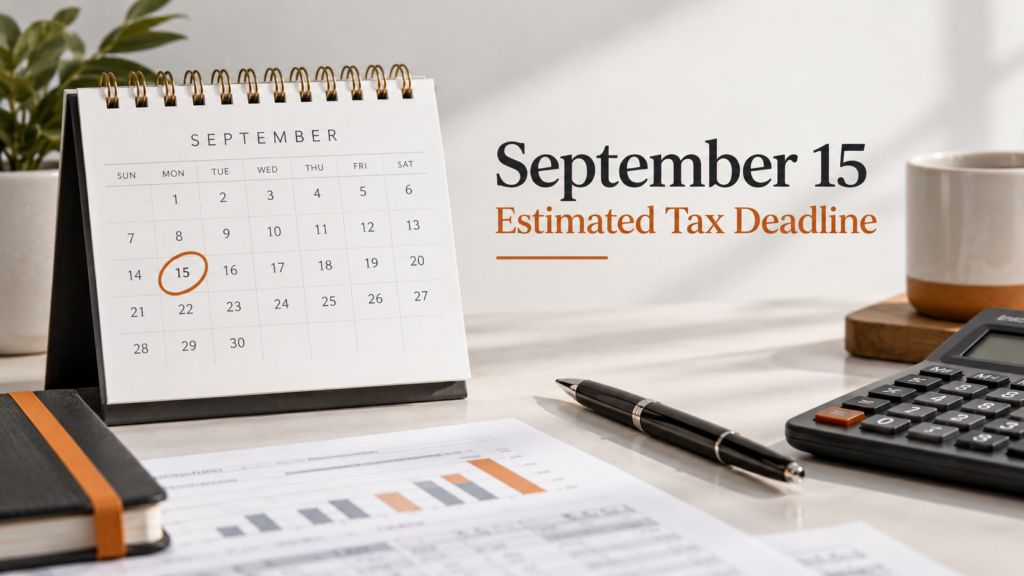
For many business owners and self-employed individuals, September 15 is simply another tax deadline on the calendar.
But in our experience, it is also a useful time to stop and ask a more important question:
Is the amount you are paying still appropriate for how your year is actually going?
The IRS generally requires taxpayers who do not have enough tax withheld during the year to make estimated tax payments. For 2026, the third estimated tax payment for individuals is due September 15. Calendar-year corporations also have an estimated tax installment due on the same date.
Your Original Estimate May No Longer Reflect Your Business
At the beginning of the year, estimated tax payments are often based on the prior year’s return or an early projection.
But businesses rarely stay exactly on plan.
By September, you may have:
- Earned substantially more or less than expected
- Added a new client or revenue stream
- Purchased equipment
- Hired employees or contractors
- Experienced higher operating expenses
- Changed your salary or distributions
- Sold an investment or other asset
Any of these changes can affect your projected tax liability.
That is why we generally do not view quarterly estimated taxes as four identical payments that should simply be made automatically.
They are opportunities to reassess the year.
Paying Too Little Can Create Problems Later
If estimated payments are too low, the result may be more than a large balance due when the tax return is filed.
Depending on the circumstances, an underpayment penalty may also apply.
On the other hand, consistently paying much more than necessary may leave money sitting with the government that could otherwise be available for business operations, savings, or investment.
The goal is not simply to pay as little as possible during the year.
The goal is to make reasonable payments based on accurate, current information.
What We Look at During a Mid-Year Tax Review
When reviewing estimated taxes for a business owner, we typically want to see more than last year’s tax return.
Current bookkeeping records can provide a much clearer picture.
Some of the items we review include:
Year-to-date profit.
How does the business’s actual income compare with the original projection?
Payroll and withholding.
For business owners who receive wages, withholding may already cover part of the expected tax liability.
Major transactions.
Large purchases, asset sales, investments, or unusual income can materially change the calculation.
Business structure.
A sole proprietor, S corporation shareholder, partnership owner, and C corporation may have very different tax considerations.
Expected activity for the rest of the year.
September still leaves enough time to make certain planning decisions before December 31.
Don’t Wait Until Tax Preparation Season to Find Out
One of the most common situations we see is a business owner who first learns how profitable the year actually was when the tax return is being prepared.
At that point, many planning opportunities have already passed.
Accurate bookkeeping and periodic tax projections allow business owners to identify issues earlier rather than reacting to them after year-end.
The September estimated tax deadline is therefore more than a payment reminder. It can serve as a useful checkpoint for the entire year.
Final Thoughts
If your income and business activity have remained relatively stable, your existing estimated tax payment may still be appropriate.
But if 2026 has turned out differently from what you expected, it may be worth reviewing the numbers before simply repeating the previous payment.
At WiseBeing Tax & Accounting, we help individuals and business owners review current financial results, estimate their tax liability, and make informed tax-planning decisions throughout the year—not just when a return is due.
Need help reviewing your 2026 estimated taxes or year-to-date business results?
Contact WiseBeing Tax & Accounting to schedule a consultation.
This article is provided for general informational purposes only and does not constitute tax, legal, or financial advice. Tax rules and their application depend on each taxpayer’s individual circumstances.Official IRS reference: The IRS’s 2026 tax calendar lists September 15 as the third estimated-tax installment deadline for individuals and certain corporations.